Insight · 13 September 2026
One door. Four reasons to walk through it. One guide who knows which is which.
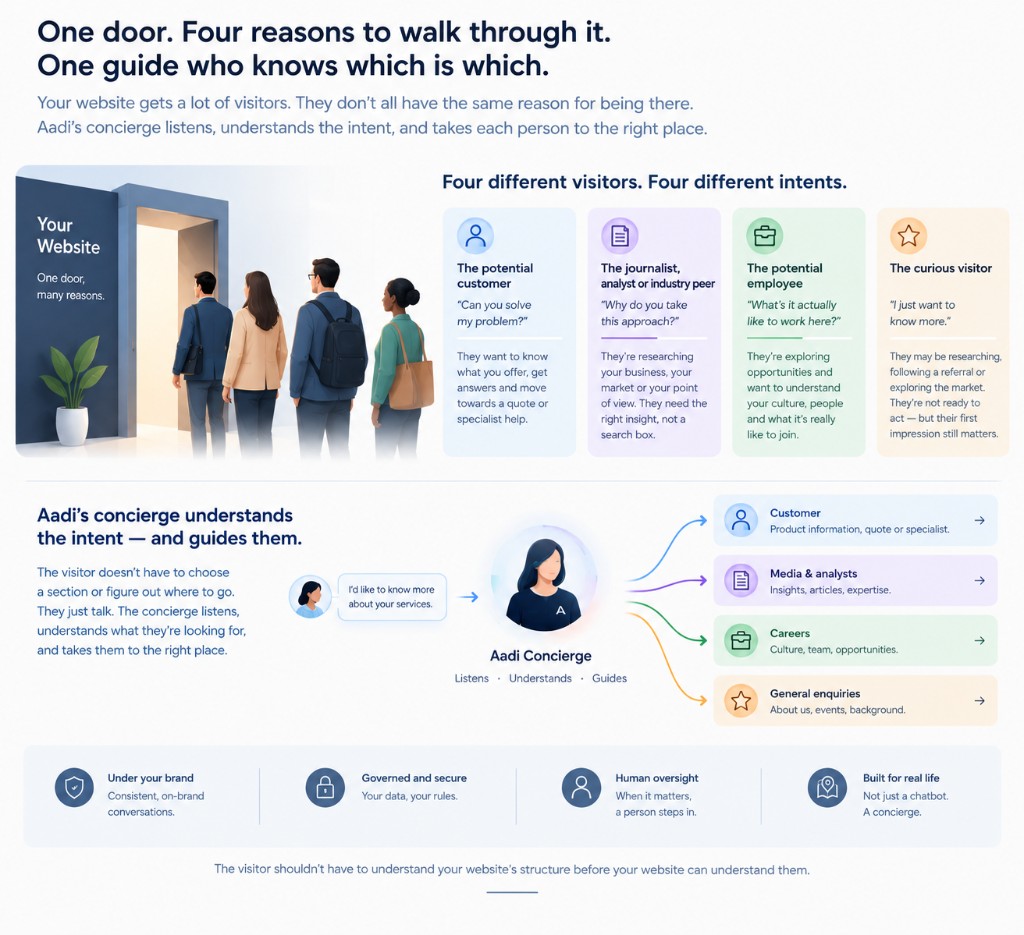
The fix for a maze isn't a better map. It's someone at the door.
That's the gap Aadi's concierge is designed to close.
We call it the silent website problem.
A website can have hundreds of pages, carefully written content and all the information a visitor could possibly need.
And still leave the person standing at the front door thinking:
“Where do I go?”
Because most websites make the visitor do the work.
Find the right page.
Work out which section matters.
Figure out what to ask.
Decide who they should contact.
A good concierge does the opposite.
It starts with the person, not the website.
A concierge, not a chatbot
Most website AI starts with a familiar idea:
Put a chat box on the homepage.
Then wait for someone to type a question.
That's useful — but it still puts the burden on the visitor.
A concierge works differently.
It greets you.
It asks what brought you there.
It understands what you're looking for.
And then it helps you get to the right place.
Think about walking into a good hotel.
You don't approach the receptionist and say:
“Please search your website for information about restaurants.”
You say:
“I'm here for dinner.”
Or:
“I'm meeting someone.”
Or:
“I'm thinking about staying here next month.”
The receptionist understands the intent behind the question and knows where to take the conversation next.
That's the difference between a chatbot and a concierge.
One answers questions.
The other helps you navigate the business.
Four visitors. Four very different reasons for being there.
Imagine four people arriving at exactly the same website.
1. The potential customer
They're interested in what you sell.
They want to know:
“Can you solve my problem?”
The concierge should qualify what they're looking for, answer the obvious questions and guide them towards the right product, service, quotation or human specialist.
This is the doorway most businesses already understand.
It's the one connected directly to revenue.
2. The journalist, analyst or industry peer
They're not necessarily looking to buy anything.
They may be researching your company, your market or your point of view.
Their question might be:
“Why do you take this approach?”
The answer may already exist in an article, insight, report or interview you've published.
But if they have to find it themselves, they may never see it.
The concierge can recognise the intent and take them directly to the thinking that matters.
3. The potential employee
They're looking at your company because they might want to work with you.
Their question isn't necessarily:
“What benefits do you offer?”
It might be:
“What's it actually like to work here?”
Or:
“Are these people doing something I want to be part of?”
Again, the answer may already be somewhere on the site.
The difference is whether someone helps them find it.
4. The person who isn't ready to do anything
And then there is everyone else.
Someone curious about your business.
Someone who has been referred to you.
Someone researching the market.
Someone who simply wants to understand who you are.
They may never become a customer.
They may never apply for a job.
They may never write an article about you.
But they are still forming an opinion.
That first impression matters.
A good concierge doesn't treat them as a failed sales opportunity.
It treats them as a person worth helping.
One door. Four reasons. One guide.
This is where the idea becomes more interesting.
The website doesn't need four different AI systems.
It needs one presence that understands why someone is there.
The visitor doesn't have to choose:
Sales
Media
Careers
General enquiry
before they can have a conversation.
They simply talk.
The concierge works out what they're trying to achieve and guides them accordingly.
The visitor shouldn't have to understand your website's structure before your website can understand them.
That's the shift.
Why a general-purpose assistant can't do this job
It's worth being precise about something here, because it's easy to assume any capable AI could be dropped onto a homepage and do what's been described above.
It can't — not out of the box.
A general-purpose AI assistant, however good the underlying model, doesn't know your four visitor types. It doesn't know which article answers which question, what your careers page should actually say to the exact candidate reading it, or where a specialist handoff needs to go when a qualified sales enquiry shows up. It's built to be helpful about everything, in general — which is precisely why it isn't, by default, helpful about your business, specifically.
That's not a limitation of the model. It's a mismatch of design intent. A general-purpose assistant is built to answer questions well across an unbounded range of topics. A concierge is built to know one particular building, thoroughly, and to route the specific people who walk into it.
Aadi's concierge isn't a general-purpose assistant with your logo added to it. It's implemented — configured against your approved content, your four intents, your routing logic, your boundaries — the same way every Aadi deployment is built around the specific business it serves, not adapted from a generic template and hoped into shape.
And it isn't just another generic AI bot
A business shouldn't put an AI on its website and simply hope it says the right thing.
Aadi's concierge works from the business's approved information, knowledge and strategies.
It operates under the company's brand and within boundaries defined by the business.
So when it answers a sales question, it isn't inventing a sales pitch.
When it discusses the company, it isn't making things up.
When it can't answer something confidently, it can say so — and guide the visitor towards a person or another appropriate route.
Helpful doesn't have to mean uncontrolled.
That is the same principle behind Aadi's wider approach to governed AI.
The difference is that here, the assistant is facing outward.
It's helping your visitors navigate your business.
Your website already has the answers.
The problem is that your visitors don't know where they are.
You probably already have:
- the product information
- the case studies
- the FAQs
- the insights
- the careers information
- the contact routes
- the people who can help
What is often missing is someone who connects the person standing at the door with the right part of the building.
That's what a concierge does.
Not another search box.
Not another menu.
Not another page for the visitor to figure out.
Someone who listens first.
Someone who knows the building.
Someone who knows which doorway matters.
And someone who can say:
“I think I can help. Let me take you there.”
One door.
Four reasons to walk through it.
One guide who knows which is which.
Try it yourself: load a site, ask by voice.
Or explore the website concierge — or ask for a short walkthrough via hello@agent-aadi.io.
Related: multi-context insight · governed digital workers · Agent Aadi