Insight · 13 September 2026
One person. Multiple contexts. One AI assistant that doesn't know how to keep them apart.
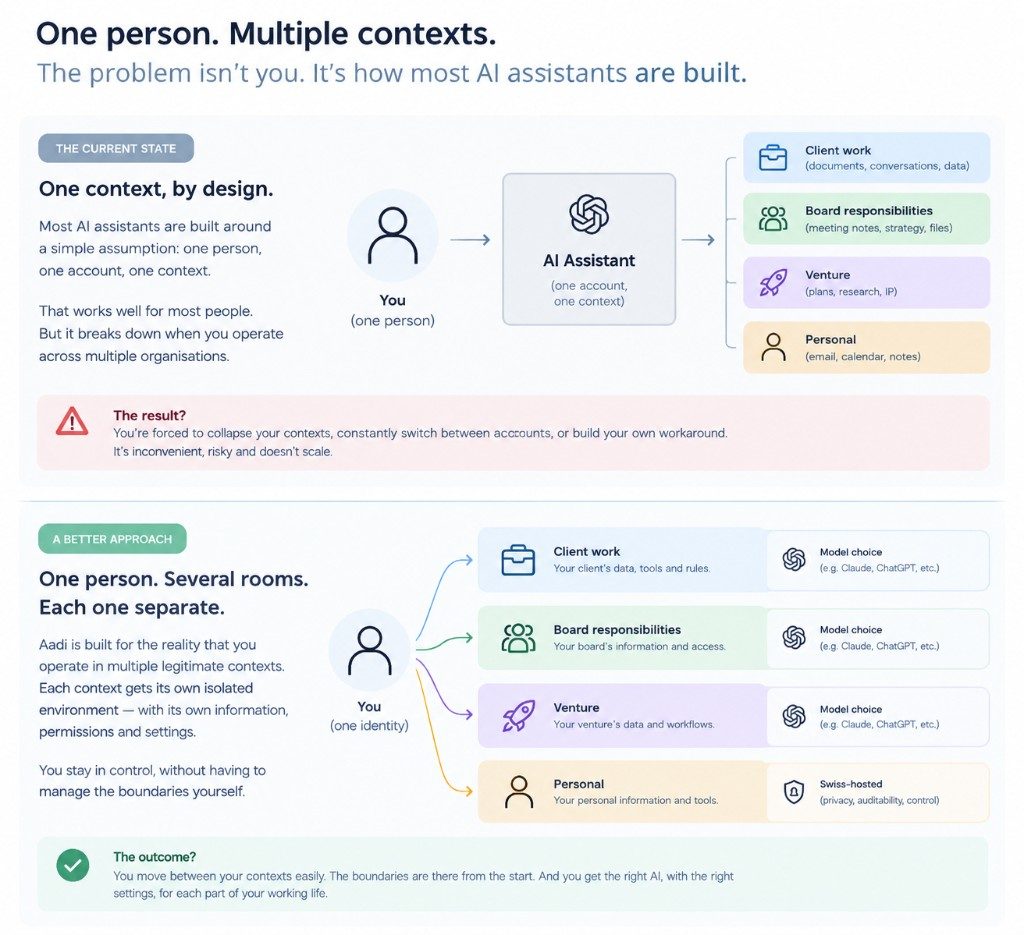
General-purpose AI assistants are largely built around a simple assumption:
One person. One account. One context.
For most people, that makes perfect sense.
You use your AI assistant for your work, your business, or your personal life. Everything belongs together.
But what happens when you are the same person — but your working life isn't one thing?
Consider a consultant working with three clients.
A fractional executive serving two businesses.
A non-executive director sitting on several boards.
Or a founder running multiple ventures.
The person is the same.
But their contexts are not.
Each organisation may have its own information, documents, conversations, systems, permissions, responsibilities and expectations of confidentiality.
Information that is perfectly legitimate in one context may be completely inappropriate in another.
And yet most AI assistants have no natural understanding of:
One person. Multiple legitimate contexts. Each one needs to remain separate.
Instead, the responsibility falls on you.
And that leaves you with three choices.
1. Put everything in one place
You connect accounts, forward information, create a central hub or otherwise bring everything together.
It's convenient.
But convenience comes at a price.
The boundaries between organisations become harder to maintain.
The very separation that existed for a reason starts to disappear.
2. Keep switching
You keep everything separate by disconnecting and reconnecting accounts, changing environments or manually moving between tools.
The boundaries remain intact.
But so does the friction.
With two contexts, perhaps you can live with it.
With five or six?
You can end up spending part of your working day managing the assistant rather than getting work done.
3. Build your own workaround
You create your own combination of accounts, folders, automations, prompts and processes.
It may work.
But now you are responsible for making the AI architecture work.
And every consultant, fractional executive, NED and multi-venture founder ends up solving essentially the same problem for themselves.
None of these is really a solution.
They are workarounds for a much simpler problem:
The AI assistant wasn't designed with your reality in mind.
The problem isn't that you have too many accounts.
It isn't that you need better folder management.
And it isn't that you need to become more technically sophisticated.
The problem is that the assistant thinks your professional life is one context.
But increasingly, it isn't.
You may be one person.
You may have one identity.
But you can legitimately operate in several different worlds — and the boundaries between those worlds matter.
Your AI assistant should understand that.
It shouldn't make you responsible for remembering which information belongs where.
It shouldn't require you to become your own identity manager, access manager and governance manager just to use AI effectively.
The assistant should carry some of that responsibility.
So what would a better approach look like?
Imagine something much simpler.
You remain one person.
But each organisation, client, board or venture has its own separate working environment.
You move between them when you need to.
You don't have to dismantle one environment to enter another.
You don't have to bring everything together into one place.
And you don't have to build the machinery yourself.
The boundaries are there from the beginning.
That is the thinking behind Aadi.
One person. Multiple contexts.
Aadi is built around a different starting point.
Instead of assuming:
One person → one environment
it starts with:
One person → multiple legitimate environments.
Each context is kept genuinely separate.
Your client remains your client.
Your board remains your board.
Your venture remains your venture.
And you remain you.
The difference is that your AI assistant can work with you across those contexts without requiring you to merge them together.
And you remain in control
Different contexts can have different requirements.
You may want the flexibility to use the AI model you prefer in one environment.
Another organisation may have stricter requirements around where its information is processed.
Another may place greater emphasis on privacy, auditability or regulatory requirements.
Those decisions don't have to be made once for everything.
They can be made in the context where they actually matter.
That's important because there is no single answer to the question:
“Which AI model should I use?”
The better question is:
“Which AI approach is appropriate for this particular context?”
Aadi is designed to let those choices coexist.
For contexts where model flexibility matters, you can choose the model that works best for you.
For contexts where privacy, data residency and control matter more, Aadi can provide a Swiss-hosted sovereign environment with human oversight and auditability built in.
The point isn't to tell you which choice to make.
The point is that the choice should be yours — and it should belong to the context.
The simple mental model
Think of it less like managing multiple AI accounts and more like having one assistant with several rooms.
You are the person moving between the rooms.
Each room has its own information, relationships and rules.
What happens in one room doesn't automatically become part of another.
You don't have to build the walls yourself.
They're already there.
That's the fundamental difference.
General-purpose AI was designed around the simpler world of one person, one account, one context.
Aadi starts from the reality that modern professionals don't always work that way.
One person can work for several organisations.
One founder can run several businesses.
One executive can sit on several boards.
And one person can legitimately need AI in all of them.
Without mixing them together.
That's not an edge case.
For a growing number of professionals, it's simply how work works.
Where we are today
Aadi's architecture separates connectors, governance and models so contexts can stay apart — with human oversight and audit where you need them. Personal / IPA-style mail tools with Approve-before-send are the live dogfood of that pattern. Broader multi-organisation Microsoft 365 and Google account multiplex continues on the product roadmap. This article describes the design intent; a conversation is the right place to match it to your stack.
One person.
Multiple contexts.
One AI assistant designed to know the difference.
Explore Agent Aadi — or ask for a short walkthrough via hello@agent-aadi.io.
Related: governed digital workers · Swiss sovereign hosting · website concierge