Insight · 3 November 2026
From Front Door to Digital Colleague
What changes when your reception can do more than answer.
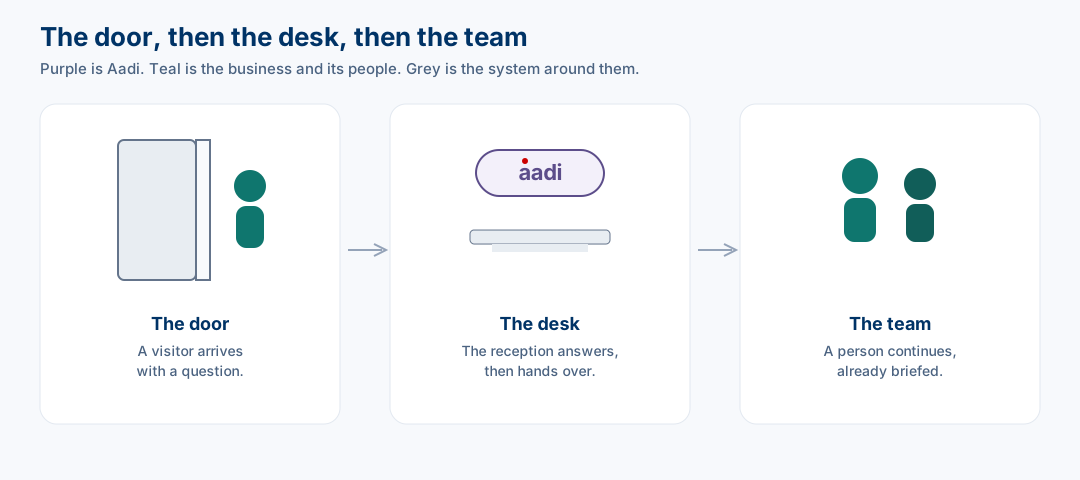
In Your Business, at the Front Door we described an intelligent reception: a first point of contact that sounds like your business, helps visitors find their way and hands over to your team with context. The natural next question is what happens when it can do more than answer.
This article looks at that next step. It is where we think customer service is heading, and, just as importantly, the conditions under which we would let an AI agent act on a customer’s behalf.
Where we are today
The reception is live today on the websites of Pretium Synergy and The Rest Is AI. It answers visitor questions, asks sensible follow-ups and passes enquiries to a person with a summary. Phone is in development and not yet available.
Everything beyond that — connecting an agent to orders, stock, shipping and returns — is the direction of travel, rather than a description of what is live. We are applying the staged approach below to our own sites first, because we would rather learn where we are accountable for the results.
The opportunity
A website and a phone line are the front door. The next step in customer service is a reliable way for a customer to get something done, not only to get an answer more quickly.
An intelligent reception can grow into a digital colleague that checks an order, updates a delivery preference, tracks a parcel, processes an eligible return, or prepares a cancellation for a person to approve. Customers get help at any hour. Routine work takes less of the team’s time. People concentrate on the conversations where judgement, empathy and authority matter.
That is the potential of an agent. Whether a particular business realises it depends on how carefully the agent is given authority.
From LLM to agent
An LLM is a general-purpose system for understanding language, reasoning through a request and producing a clear response. Ask it “What are your opening hours?” and it can answer well, if it has been given the right business information.
By itself it is a conversational engine. It does not inherently know a business’s policies. It cannot see an order. It cannot change a stock level. It should not cancel an order or issue a refund on its own say-so.
An agent is that engine with four things added.
- A role and a goal. “Be the front door for customer enquiries and resolve what you safely can.”
- Knowledge. Approved answers on products, services, prices, policies, opening hours and delivery options.
- Tools. Secure connections to the systems where the work lives: orders, inventory, shipping, returns, a CRM, a calendar.
- Guardrails. Identity checks, action limits, escalation rules, and human approval for sensitive actions.
The agent then works in a loop. It understands what the customer needs, checks the relevant information, uses a tool where one is needed, confirms the result, and either completes the task or hands over to a person with the context intact.
An LLM answers. An agent resolves.
How it grows
Stage 1: The intelligent reception
This is the reception we described in the first article, and the stage we have live on the web today. The agent answers from approved knowledge. “Do you deliver to my area?” “Can I return this if it does not fit?” It asks a follow-up when it needs one. It recognises when a person should take over: a complex complaint, an urgent issue, or a customer who asks for a human. It passes on the transcript, the customer’s details and the reason for the handover, so nobody starts again.
Stage 2: From conversation to action
Once a front-door agent is reliable, it can be connected to the systems where the work actually happens.
Imagine a customer who has ordered a home EV charger and writes: “Can I switch to the tethered version, and when will it arrive?” The agent can:
- Look up the order and check whether it can still be amended.
- Check stock to see whether the tethered version is available.
- Update the order, or request approval if policy requires it.
- Check the shipping status and give a delivery update taken from the shipping system.
- Confirm the change and log the interaction.
The same shape applies when the “order” is not a parcel. For example, a visitor might ask whether a firm covers their area, whether someone can visit on Thursday, or what a supplier assessment would need from them. The agent looks up the relevant record, does the small thing the rules allow, and prepares the rest for a person.
At this stage it is doing a small, governed piece of work rather than only explaining the business.
Stage 3: Returns, cancellations and exceptions
The next stage covers the workflows that consume the most staff time.
- Start a return and produce the correct instructions or label.
- Check whether an item is eligible under the returns policy.
- Cancel an order before dispatch, or explain why it cannot be cancelled.
- Track a delayed shipment and update the customer from the carrier’s record.
- Raise a refund request, subject to limits and approval rules.
- Escalate disputes, damaged goods or repeated issues to a human colleague.
The agent is not invited to “decide” these outcomes. It follows the business’s rules: which orders can be cancelled, which returns qualify, which refunds need approval, and when a human must take over.
A practical rollout
Trust is earned at each stage before the agent is given more authority.
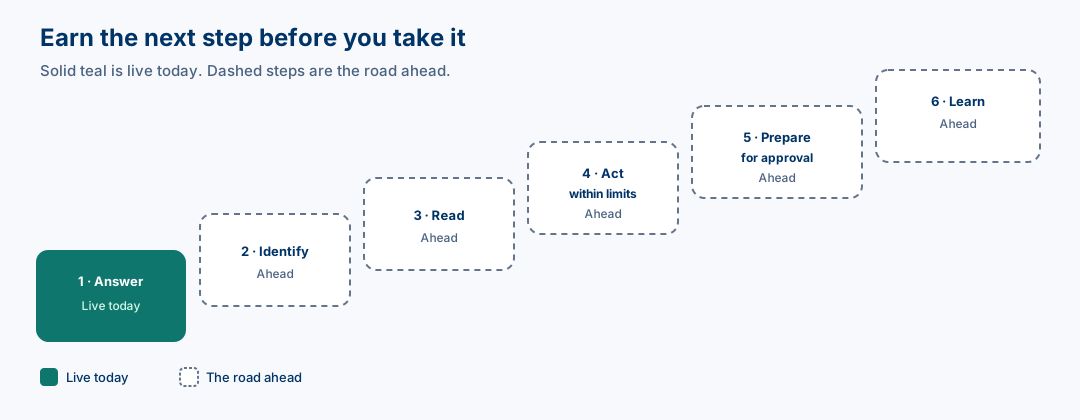
- Answer. Connect it to approved business knowledge so it can handle common questions.
- Identify. Let it recognise the customer securely and retrieve the relevant order or account.
- Read and recommend. Let it check status, stock and shipping, explain the position, and propose a next step.
- Act within limits. Allow low-risk actions where policy already permits them.
- Prepare high-stakes actions. For refunds, cancellations, exceptions or account changes, have it assemble the facts and request human approval.
- Learn and improve. Review escalations, failed resolutions and feedback. Update knowledge, rules and permissions.
Autonomy expands only as evidence, controls and confidence grow.
The risk: hallucination
The most important risk is hallucination: an LLM can produce a confident, fluent answer that is wrong or unsupported. In customer service, that might mean inventing a returns deadline, promising a refund, misreading an order or claiming a parcel has shipped when it has not. Hallucinations do not sound like guesses. They sound authoritative.
The risk also changes in kind once the agent can act. A chatbot may give a wrong answer; an agent may cancel the wrong order, create an incorrect return, update the wrong address or send a customer false reassurance. Hallucination becomes an operational, financial and trust risk, not merely a communication problem.
Other failures follow from the same gap:
| Risk | What it looks like |
|---|---|
| Unauthorised promises | Discounts, replacements or exceptions outside policy |
| Wrong actions | Acting on the wrong customer, order or account |
| Privacy failures | Revealing information to someone who has not been verified |
| Error cascades | One false assumption leading to a chain of bad tool calls |
| Loss of trust | Inconsistent or contradictory answers |
| Compliance exposure | Mistakes on eligibility, policy or consumer rights |
What makes an agent trustworthy
Making the model “smarter” is not a sufficient answer. The knowledge, the permissions and the actions have to be checkable.
- Ground every answer. Use approved knowledge and live system data. The agent should distinguish what it was told, what it retrieved, and what it is inferring.
- Permit uncertainty. If the answer is not in an approved source or the order system, it says so, asks a clarifying question, or escalates. It does not improvise.
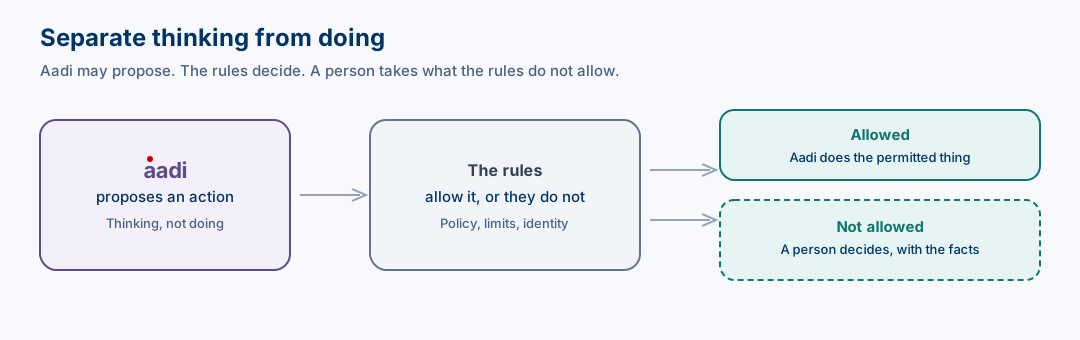
- Separate thinking from doing. The model may propose an action. Policy checks and fixed rules decide whether the action is allowed.
- Use tools as evidence. “Your order has shipped” comes from the shipping system, not from a plausible sentence.
- Set hard limits. No refund above a threshold. No cancellation after dispatch. No address change without verification. No exception without approval.
- Escalate by design. Uncertainty, disputes, vulnerable customers, high-value transactions and repeated failures go to a person, with the facts attached.
- Keep an audit trail. Record the question, the sources retrieved, the tool calls, the decision and the final response, so an error can be investigated and the rule tightened.
This is the thinking behind governed digital workers. The data handling underneath it is covered in our note on Swiss sovereign hosting.
The front door should be welcoming, but it should never make promises the house cannot keep.
Authority stays with people
In the first article we said that specialist advice, commitments and decisions stay with people. That still holds for an agent with tools. Processing a return or preparing a cancellation is action inside a rulebook the business wrote: the thresholds, the eligibility checks, the approval steps. Anything outside that authority goes to a person, with the facts already assembled.
A hybrid team
The goal is not to remove people from customer service. It is to change what they spend their time on. As the agent takes routine enquiries, order checks and eligible returns, colleagues can focus on complex complaints, vulnerable customers, exceptions and relationship recovery.
Managers take on five jobs: assign the work, supervise the agent, set its authority, coach the team through the change, and keep improving the system. Coaching is the one most easily skipped. People need to see the agent as support, not as a replacement, or they will work around it or fear it. A simple habit makes the improvement job real. Once a week, review the escalated and failed conversations, ask where the handover should have happened sooner, and update the knowledge, the rules and the permissions.
Questions to ask before an agent is given tools
- Which three or four actions would save the team the most time, and which of them are low-risk?
- What does the agent need to see in each system, and what should it never be able to change?
- Which decisions need a human approval step, and above what value?
- How will the agent verify who it is talking to before it shares order details?
- What will you review each week to decide whether it has earned more authority?
What we are doing next
We are running the reception live on two sites, extending it to the phone, and applying this staged approach to our own businesses before recommending it to anyone else. We will share what works and what we change.
If you would like to think through which stage fits your business, start with the ten questions your visitors ask most often, plus the three tasks your team repeats most. Send them to hello@agent-aadi.io, or see a reception on a public site.
Start with an AI reception that answers the front door. Grow it into an AI colleague that can check the order, update the system, track the parcel, process the return, and knows exactly when to call a human.
The future customer-service team is hybrid: AI agents for speed, consistency and routine work; people for judgement, empathy and accountability.
Related: all insights · your business, at the front door · Agent Aadi